Which screen aspect ratio should a dedicated home cinema be designed around?
Films, series, and sports arrive in different shapes, and the screen you build determines which of them fills the frame. Here is how to decide between a 16:9 screen and a wide scope screen, and what each demands of the projector.
The shapes the content comes in
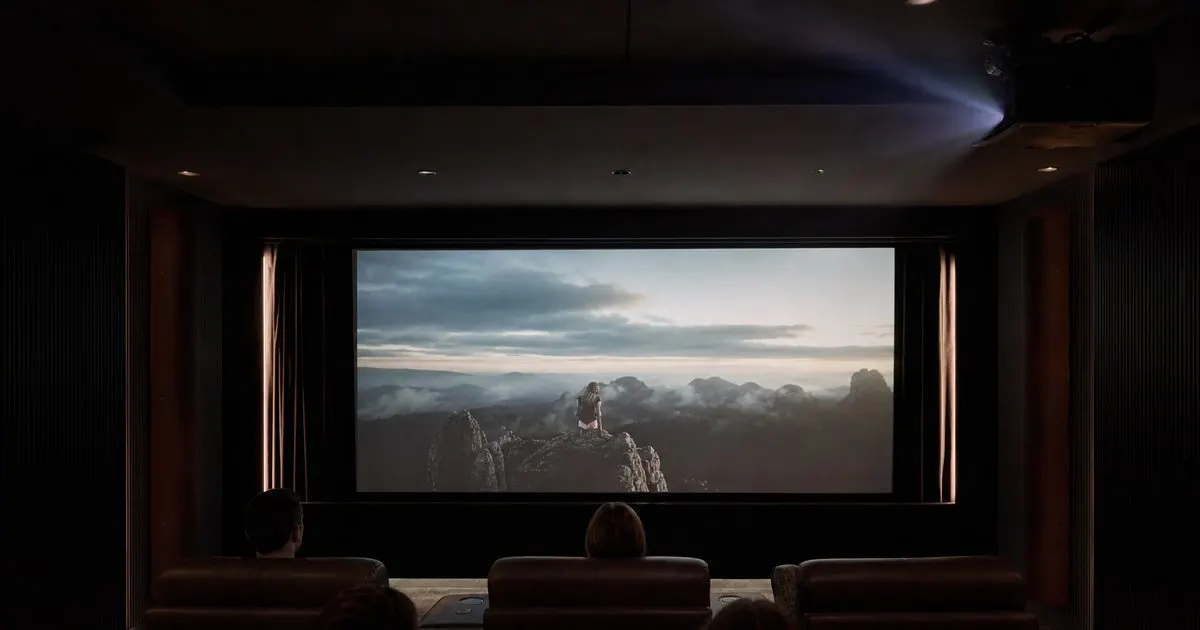
Nearly everything broadcast or streamed as episodic television is produced at 16:9, the shape of every flat panel television. Most theatrical films are wider, either at roughly 1.85:1, which is close to 16:9, or at the wide scope ratio around 2.39:1 that most blockbusters and prestige dramas use. Some recent films switch ratios within the same running time. On a 16:9 screen, a scope film appears with black bars above and below and uses only about three quarters of the screen height. On a scope-shaped screen, the wide films fill the frame and 16:9 content sits in the middle with unused screen on either side.
The decision therefore comes down to what the room is for. A household that watches mostly films, and cares that the biggest, most cinematic titles feel biggest, leans toward scope. A household that spends more hours on series, sport, and games, all of which are 16:9, is better served by a 16:9 screen sized as large as the seating distance allows. Neither is wrong, but it is worth being honest about actual viewing habits rather than aspirational ones before committing to a screen that is very hard to change later. Related: Why does screen size depend on viewing distance more than budget?
Keep reading: How dark does a dedicated home cinema room need to be?, Which projector technology delivers the best image in a light controlled room?, What acoustic treatments actually transform a home theater listening experience?. See how Theatrvault helps you an expert guide to designing a true home cinema.
Constant image height and how the projector delivers it
A scope screen is usually run in constant image height mode: the picture keeps the same height for every format and grows wider for scope films, which mirrors how commercial cinemas present them. Getting a 16:9 projector to fill a scope screen can be done in two ways. The zoom method uses the projector's motorized lens to enlarge a scope film until its active picture fills the width, with the black bars falling harmlessly onto the frame or masking above and below. Projectors with lens memory store the positions for each format so switching takes a button press.
The alternative is an anamorphic lens, an external optic that stretches the projector's full panel horizontally to the scope shape while the projector applies a matching vertical stretch to the image. Because every pixel of the panel is used, this approach yields more light on screen and uses the full panel resolution, and with a high-grade lens it can be sharper than zooming. The cost is a precision lens, a sled to move it in and out of the light path, and careful alignment. It suits rooms where the scope screen is large and brightness is at a premium; the zoom method suits rooms where simplicity and budget matter more. Related: Which projector technology delivers the best image in a light controlled room?
Masking, and why the frame matters as much as the fabric
Whichever shape you choose, some content will not fill it, and the unused area looks best when it is truly black. Projectors never produce perfect black in the bars, and a faint gray rectangle beside or above the picture is distracting. Masking systems solve this with motorized black velvet panels that close in to frame the active image exactly. Side masking on a scope screen crops the sides for 16:9 content; top and bottom masking on a 16:9 screen crops the bars for scope films. Four-way systems handle every ratio and are the reference approach in bespoke rooms.
Masking is a meaningful expense and a mechanical element that needs to be integrated with the control system so it moves automatically with the source's aspect ratio. In rooms where that is out of reach, a wide black velvet frame around the screen absorbs much of the overspill from the zoom method, and a dark, matte finish on the wall behind takes care of the rest. Fixed-frame screens with generous velvet borders are, for that reason, worth prioritizing over borderless designs in a projection room. Related: How dark does a dedicated home cinema room need to be?
Making the decision for your room
Start with the room's width and the seating distance. A scope screen of a given height is wider than a 16:9 screen of the same height, so it needs more wall width and, if the speakers flank it, more still. In a narrow room, a scope screen may end up with the same width as a 16:9 screen and simply less height, which gives away picture on every 16:9 title for no gain on the films. In a wide room with the speakers behind the screen, the scope shape often fits naturally and looks spectacular. Related: What is the best way to light a home cinema without washing out the picture?
Then consider the projector. The zoom method needs a lens with enough zoom range and lens memory to cover both positions from your throw distance, and it costs a little brightness on scope content because only part of the panel is used. An anamorphic setup recovers that brightness but adds cost and complexity. Some owners find a good compromise in a 16:9 screen sized so that the scope image is still very large, accepting bars on the biggest titles in exchange for full-frame series and sport. There is no universal answer, only the one that fits your content and your walls.
- Choose scope if films dominate your viewing and 16:9 if series, sport, and games take more of your hours.
- Constant image height on a scope screen is delivered by lens zoom with memory positions or by an anamorphic lens.
- Motorized masking, or at minimum a wide velvet frame, keeps unused screen area from glowing gray.
- Check room width and speaker placement first, since a scope screen in a narrow room may only lose height rather than gain width.

Julien Jimenez
Julien Jimenez is an independent software builder based in Paris. He designs, ships, and operates focused SaaS products for small businesses and independent professionals. Read the full author page.
A Cinema Kept Behind Your Own Door
An expert guide to designing a true home cinema. Theatrvault is built to help you put this into practice.
Design your cinemaMore from the Theatrvault blog
Get the complete home cinema rooms guide
Our full buying guide, the price guide, and new research as we publish it. One email, no spam, unsubscribe any time.