When should a home cinema use an acoustically transparent screen in front of the speakers?
Putting the front speakers behind the screen is how commercial cinemas anchor dialogue to the picture. Here is when that approach pays off at home, and when a solid screen is the smarter choice.
What an acoustically transparent screen solves
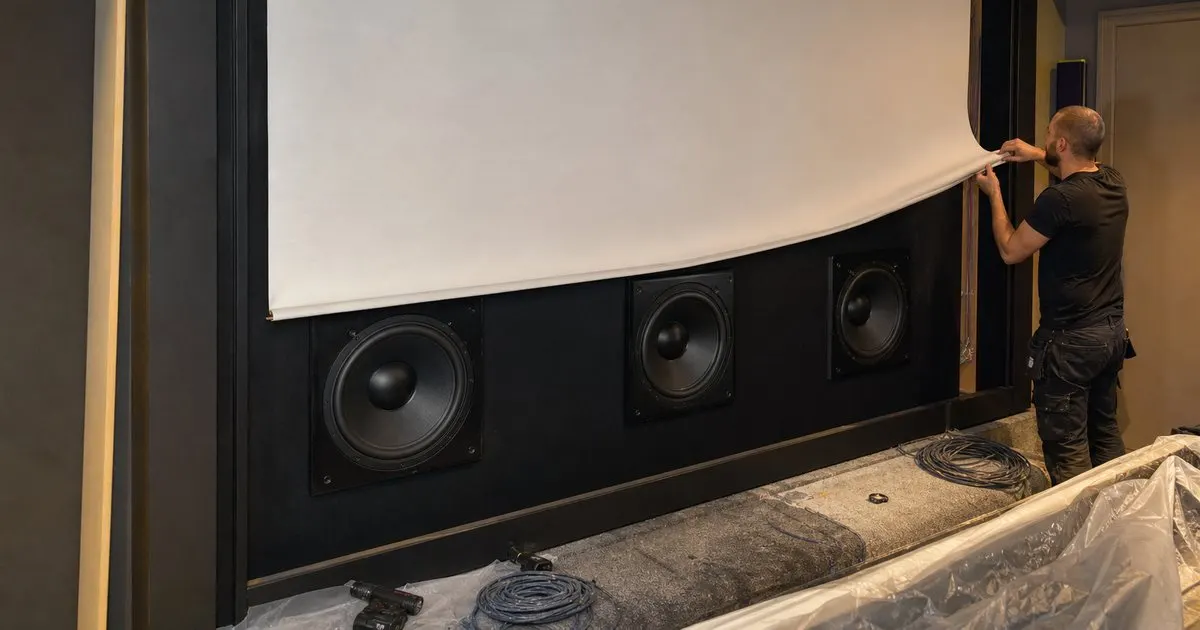
In a room with a solid screen, the center speaker has to go somewhere, and the choices are all compromises. Below the screen it sits well under the mouths of the actors, and dialogue seems to come from the floor. Above the screen it pulls voices toward the ceiling and usually forces a lower screen than the room could otherwise support. Left and right speakers pushed outside the screen edges widen the soundstage beyond the picture. As screens grow, these offsets grow with them, and the disconnect between what you see and where you hear it becomes noticeable in every scene with dialogue.
An acoustically transparent screen removes the constraint. The three front speakers sit behind the image at the correct height, typically with tweeters near the vertical center of the screen, and the sound appears to come from the actors themselves. It also frees the screen to be as large as the room's geometry allows, since nothing has to fit above or below it. And it opens the door to a baffle wall, where the speakers are flush-mounted into a solid, damped front wall, which controls low-frequency behavior and removes reflections off the front wall and cabinet edges.
Keep reading: How dark does a dedicated home cinema room need to be?, Which projector technology delivers the best image in a light controlled room?, What acoustic treatments actually transform a home theater listening experience?. See how Theatrvault helps you an expert guide to designing a true home cinema.
Woven versus perforated, and what you give up
Two families of material exist. Woven fabrics let sound pass through the gaps in the weave and are the common choice in home rooms because they show no visible pattern and interact gently with high-resolution projectors. Perforated vinyl, the commercial cinema standard, has tiny punched holes; at home viewing distances the hole pattern can be visible and can produce moire with a fine pixel structure unless the perforations are very small, which in turn restricts how much sound passes. Either way, both types attenuate the highest frequencies slightly, and a good installer compensates with equalization in the processor. Related: Should you build a dedicated cinema or a multipurpose media room?
The trade is light. Any transparent material reflects a bit less of the projector's output than a solid screen of the same design, so the projector needs a small brightness margin, and the space behind the screen must be finished in black so that light passing through does not bounce back and gray out the image. Most ambient light rejecting materials are not acoustically transparent, so a room that depends on rejecting stray light for daytime viewing is generally not a candidate. The screen is not a fix for a poorly darkened room; it belongs in a properly light controlled one. Related: How dark does a dedicated home cinema room need to be?
The room conditions that make it the right call
The approach makes the most sense when the room is being built or gutted, because it needs depth. Speakers behind the screen require a cavity, typically somewhere in the range of a foot to a foot and a half from the screen surface to the front wall, more if a baffle wall with large speakers is planned. That depth comes out of the room's length, so a long room absorbs it comfortably and a short one may not. It also suits rooms where the intended screen is large relative to the wall, where a solid screen would force awkward speaker placement, and rooms with multiple rows where a correctly placed center channel benefits the back seats as well as the front. Related: How many seats can a luxury home cinema comfortably accommodate?
A solid screen remains the better answer in several situations. If the room is shallow, the cavity costs too much seating distance. If the screen will be modest in size and speakers can flank it at a sensible height with the tweeters close to the image center line, the gain is small. If the owner wants maximum light output for a slightly compromised room, or intends to use an ambient light rejecting surface, the physics point the other way. And if the budget cannot stretch to speakers designed for behind-screen placement, which need to be robust and well-controlled in output, it is better to place a very good pair of conventional speakers well than a lesser set behind fabric. Related: Which projector technology delivers the best image in a light controlled room?
Getting the installation right
Behind-screen speakers should be angled toward the main seating and, ideally, mounted in a baffle wall or a heavily damped, black-finished cavity. Everything behind the screen, including cable, brackets, and the wall itself, should be flat black to swallow transmitted light. The screen frame needs to sit far enough forward that the speaker fronts do not touch the fabric and that the tweeters are as close to the material as the design allows, since distance between driver and screen affects the sound as much as the material does. Subwoofers can also live behind the screen, which conveniently hides them, though their placement should still be chosen for the room's bass response rather than for tidiness alone.
After installation, measurement is not optional. The installer should measure the response of each front speaker through the screen from the main seat and apply correction in the processor for the high-frequency loss, then confirm that dialogue intelligibility and tonal balance match the surround speakers, which are not behind fabric. A quick comparison with the screen fabric temporarily rolled aside is the honest test. When it is done well, listeners forget the screen is there and simply notice that voices come from faces, which was the whole point.
- Behind-screen speakers put dialogue at the actors' mouths and allow the largest screen the room's geometry can support.
- Woven fabrics suit home rooms best; perforated materials risk visible patterns and moire at domestic viewing distances.
- The approach needs a black-finished cavity of roughly a foot or more behind the screen, so it favors new builds and longer rooms.
- Measure through the screen and equalize the high-frequency loss, then check the result against the fabric rolled aside.

Julien Jimenez
Julien Jimenez is an independent software builder based in Paris. He designs, ships, and operates focused SaaS products for small businesses and independent professionals. Read the full author page.
A Cinema Kept Behind Your Own Door
An expert guide to designing a true home cinema. Theatrvault is built to help you put this into practice.
Design your cinemaMore from the Theatrvault blog
Get the complete home cinema rooms guide
Our full buying guide, the price guide, and new research as we publish it. One email, no spam, unsubscribe any time.