Can a bespoke home cinema be simple enough for a house guest to operate?
A dedicated cinema involves a projector, a processor, lighting scenes, masking, and several sources. The mark of a well-integrated room is that none of that complexity reaches the person holding the remote.
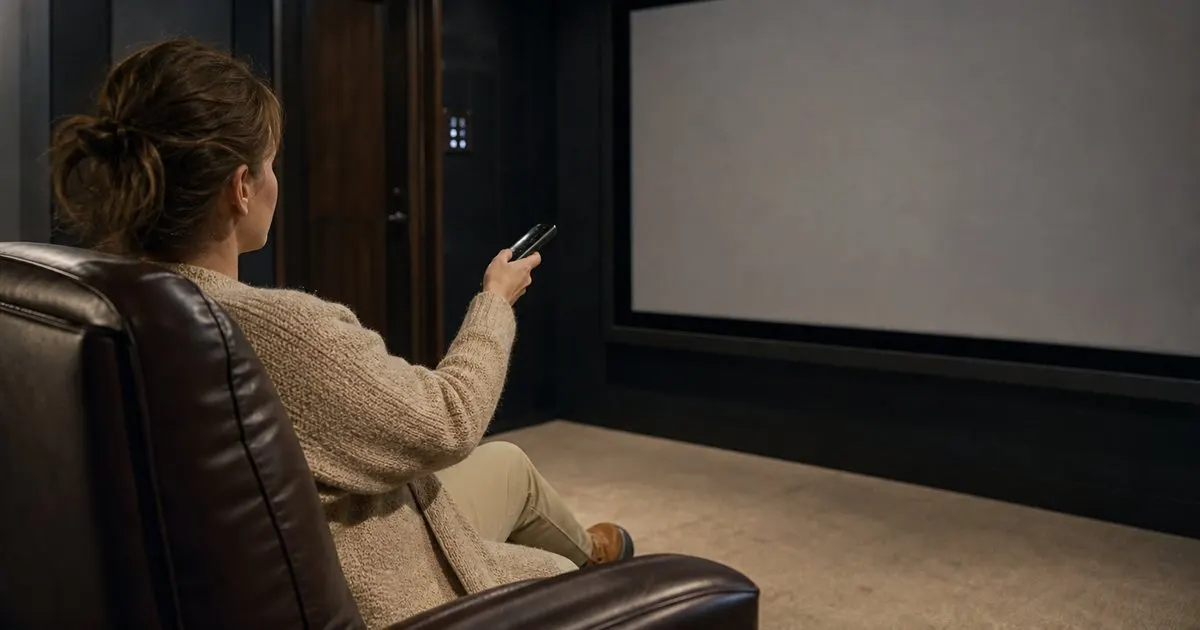
What complexity looks like from the seat
A dedicated cinema at this level has more devices than most people realize: a projector with its own warm-up and lens memory, a surround processor and amplifiers, a disc player, one or more streaming devices, a lighting controller, a motorized screen or masking, and often a shade, a thermostat, and a rack fan. Left to their own remotes, the evening begins with a hunt for the right one and a sequence of buttons in the correct order. Miss one and there is no picture, or picture with no sound, or a scope film playing in the wrong lens position. Related: Which projector technology delivers the best image in a light controlled room?
Guests, and often the owner's family, will not learn that sequence. The test of a good control design is whether someone who has never been in the room can sit down, press one clearly labeled button, and have the lights dim, the screen and projector wake, the right source appear, and the sound come on at a sensible volume. Everything else in the system exists to make that one press work reliably every time. A cinema that only its owner can start is, in practical terms, a cinema that gets used less. Related: How dark does a dedicated home cinema room need to be?
Keep reading: How dark does a dedicated home cinema room need to be?, Which projector technology delivers the best image in a light controlled room?, What acoustic treatments actually transform a home theater listening experience?. See how Theatrvault helps you an expert guide to designing a true home cinema.
The anatomy of a one-touch room
Professional control platforms achieve this through activities or scenes: a single command that sends the correct instructions to every device in the correct order, with the right delays. Pressing a button labeled with the source name powers on the projector and processor, waits for them to become ready, selects the input, sets the lighting to the pre-show scene, positions the masking for the expected aspect ratio, and hands the user a simple remote layout with play, pause, volume, and navigation. Ending the evening reverses it all with one press. The remote itself can be a compact handheld with a few hard buttons, a small touch panel, or both.
Two-way communication is what separates a reliable system from a fragile one. When devices are controlled over the network or a serial connection, the controller knows whether the projector is actually on and which input the processor is actually using, and it can correct itself. Infrared control is one-way; the controller sends a command and hopes. Discrete commands, meaning separate codes for on and off rather than a toggle, prevent the classic failure where a device ends up out of step with the rest. A good integrator specifies devices with proper network control for exactly this reason.
Design choices that keep it simple
Restraint is the discipline. Every additional option on the remote is something a guest can press by accident. The best guest-facing interface shows only the sources that are used and hides the settings, picture modes, and calibration menus behind a lock or on a separate page. Aspect ratio switching, mode selection for HDR, and lighting transitions should be automatic, driven by the signal, not by the user. A keypad by the door with a small number of engraved buttons, such as lights, movie, and off, is a quietly effective addition, since it lets someone recover the room without finding the remote at all. Related: How do you ventilate a sealed home cinema room without adding audible noise?
Volume deserves particular attention. Store a sensible default level in the start-up sequence so that a film never begins at the level the last guest left it, and consider a maximum limit for unattended use. Include an obvious way to pause and to raise the lights for a break. A laminated one-page card in the room, with three or four lines of instruction, is not a failure of design; it is the last mile of it. Owners who have used the room for months forget how much they know.
Reliability, service, and the long term
A control system is software, and software needs maintenance. Streaming devices update themselves and occasionally change behavior, the processor may receive firmware that alters its startup, and every change has the potential to break a sequence that has worked for a year. A relationship with the integrator who programmed the room, often through a service agreement with remote access to the system, means these issues are corrected before the next screening rather than discovered during it. Ask at the outset how support is handled and what it costs.
Insist on documentation: a list of every device, its network address, its control method, and the logic of each activity, stored somewhere the owner can find it. Managed power sequencing at the rack, with a hard reset path, lets someone restore a stuck system without a service call. Finally, resist the temptation to automate everything. The goal is a room where the technology has receded so far that a guest simply watches the film and, at the end, says the picture was wonderful, without ever having thought about how it started. Related: What is the best way to light a home cinema without washing out the picture?
- A well-designed cinema starts with one button that powers, configures, and dims everything in the right order.
- Two-way network or serial control with discrete commands keeps devices in step and lets the system correct itself.
- Show guests only what they need, automate mode and aspect changes from the signal, and set a default volume.
- Plan for service and documentation, because firmware changes will eventually alter a sequence that once worked.

Julien Jimenez
Julien Jimenez is an independent software builder based in Paris. He designs, ships, and operates focused SaaS products for small businesses and independent professionals. Read the full author page.
A Cinema Kept Behind Your Own Door
An expert guide to designing a true home cinema. Theatrvault is built to help you put this into practice.
Design your cinemaMore from the Theatrvault blog
Get the complete home cinema rooms guide
Our full buying guide, the price guide, and new research as we publish it. One email, no spam, unsubscribe any time.