How many subwoofers does a dedicated cinema room need for smooth, even bass?
Bass in a small room is governed by the room, not the subwoofer. Here is why one subwoofer almost never delivers even low frequencies across a row of seats, and how two or four change the result.
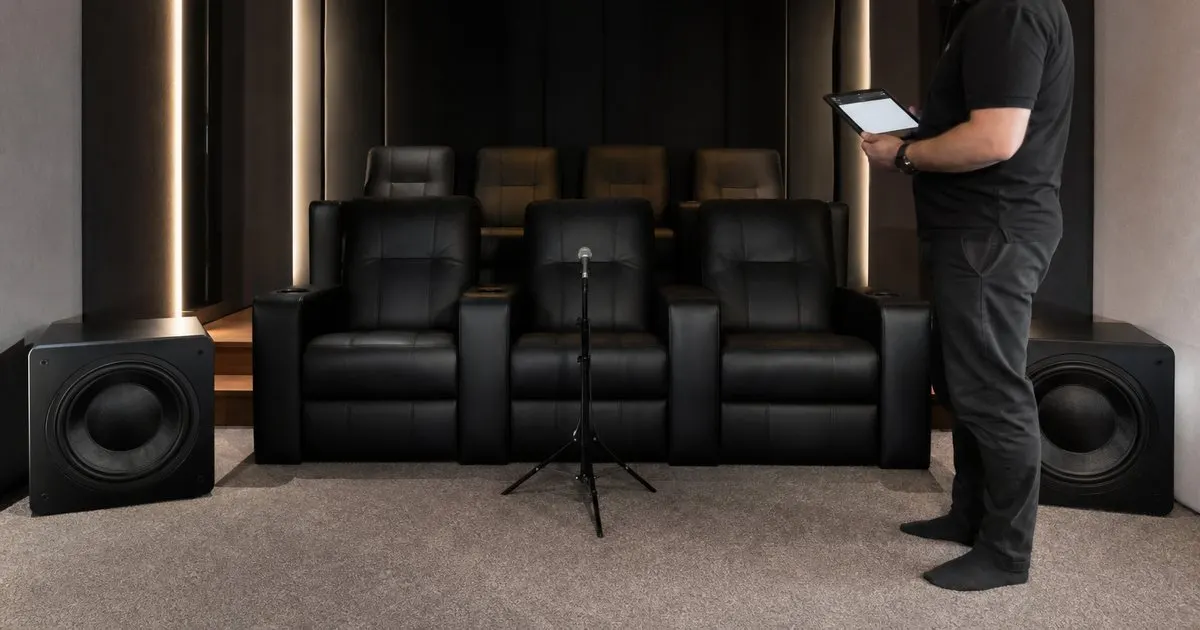
Why one subwoofer produces uneven bass
At low frequencies, a domestic room behaves like a resonant box. Sound waves at certain frequencies fit neatly between opposing walls, floor and ceiling, and they reinforce themselves into standing waves called room modes. At those frequencies, some positions in the room experience a strong peak and others a deep null, sometimes only a few feet apart. Move from the center seat to the one beside it and a particular bass note can go from boomy to nearly absent. This is a property of the room's dimensions and it exists regardless of how expensive the subwoofer is.
A single subwoofer excites those modes from one point, and its position determines which peaks and nulls fall on which seats. You can find a position that sounds good at one seat, but the others typically suffer. Equalization cannot fix a null, because boosting a frequency that cancels at a seat simply pushes more energy into the cancellation. The tool that actually addresses the problem is multiple sources: several subwoofers placed so that their contributions to each mode partly cancel out the seat-to-seat differences, leaving a response that is much more consistent across the row, which equalization can then polish. Related: How many seats can a luxury home cinema comfortably accommodate?
Keep reading: How dark does a dedicated home cinema room need to be?, Which projector technology delivers the best image in a light controlled room?, What acoustic treatments actually transform a home theater listening experience?. See how Theatrvault helps you an expert guide to designing a true home cinema.
What two subwoofers change, and what four add
Two subwoofers placed at the midpoints of opposite walls, or in opposing corners, produce a noticeably more even response across the seats than one, and they also share the workload, so each operates with more headroom and lower distortion at the same output. For a single row of seats in a moderately sized room, a well-placed pair is often the sensible target, and it is the configuration most experienced installers recommend as a minimum for a dedicated room. Related: Should you build a dedicated cinema or a multipurpose media room?
Four subwoofers, one at the midpoint of each wall or one in each corner, extend the benefit further, particularly in rooms with two or three rows, where front-to-back variation is as much of a problem as side-to-side. The acoustics literature on small-room bass consistently favors these symmetric multi-subwoofer arrangements for seat-to-seat consistency. Beyond four, the improvements diminish for most rooms, and the effort is better spent on measurement, integration, and, where wanted, tactile transducers in the seating for the physical sensation of low frequencies at sensible listening levels. Related: What acoustic treatments actually transform a home theater listening experience?
Placement and integration in practice
The symmetric positions are the starting point, not a rule. Real rooms have doors, risers, a screen wall, and equipment closets, and the best available positions are found by measurement. An installer places the subwoofers, measures the response at every seat with a calibrated microphone, and moves them until the seat-to-seat variation is minimized, then applies delay and level adjustments so the units work together rather than fighting. Only then is global equalization applied to shape the combined response. This ordering matters; equalizing first and placing second wastes the advantage of multiple units.
Modern surround processors include automatic room correction that handles much of the integration, and many support separate outputs for multiple subwoofers with independent delay and level. For the best result, a dedicated bass management processor or a skilled technician with measurement software goes further. Crossover settings between the subwoofers and the main speakers, and the blend around that crossover, are where a system either sounds seamless or reveals where the subwoofers are. Well-integrated bass does not draw attention to itself; it simply makes the whole system sound larger and more effortless.
Choosing the units and the budget balance
In a multi-subwoofer system, matching units are strongly preferred, because identical output and behavior make integration far easier. Sealed designs tend to be more compact and offer tight, controlled bass with a gentle low-frequency roll-off that a room's natural gain helps offset, while ported designs deliver more output at the very lowest frequencies for a given size. In a dedicated cinema, where the deepest effects in film soundtracks matter, either can work well provided the total output capability suits the room volume and the owner's listening levels. Related: How dark does a dedicated home cinema room need to be?
Budget-wise, two moderate subwoofers almost always outperform one expensive unit in a multi-seat room, because the room's modal behavior, not the driver, is the limiting factor. As an independent guide we may earn a commission on some products, and this remains our honest position. Plan the electrical outlets and signal cabling for four positions during construction even if two units are the initial purchase; the marginal cost is trivial and it leaves the door open to a straightforward upgrade after the room has been measured and lived in.
- Room modes, not subwoofer quality, cause the peaks and nulls that make bass differ from seat to seat.
- Two subwoofers at opposing wall midpoints or corners are the practical minimum for a dedicated cinema.
- Four symmetric units suit multi-row rooms; beyond that, measurement and integration deliver more than extra boxes.
- Place by measurement first, then set delay and level, and only then apply equalization.

Julien Jimenez
Julien Jimenez is an independent software builder based in Paris. He designs, ships, and operates focused SaaS products for small businesses and independent professionals. Read the full author page.
A Cinema Kept Behind Your Own Door
An expert guide to designing a true home cinema. Theatrvault is built to help you put this into practice.
Design your cinemaMore from the Theatrvault blog
Get the complete home cinema rooms guide
Our full buying guide, the price guide, and new research as we publish it. One email, no spam, unsubscribe any time.