How do you ventilate a sealed home cinema room without adding audible noise?
A properly isolated cinema is an airtight box, and airtight boxes get hot and stuffy fast. Here is how designers move air through the room while keeping the mechanical system inaudible from the seats.
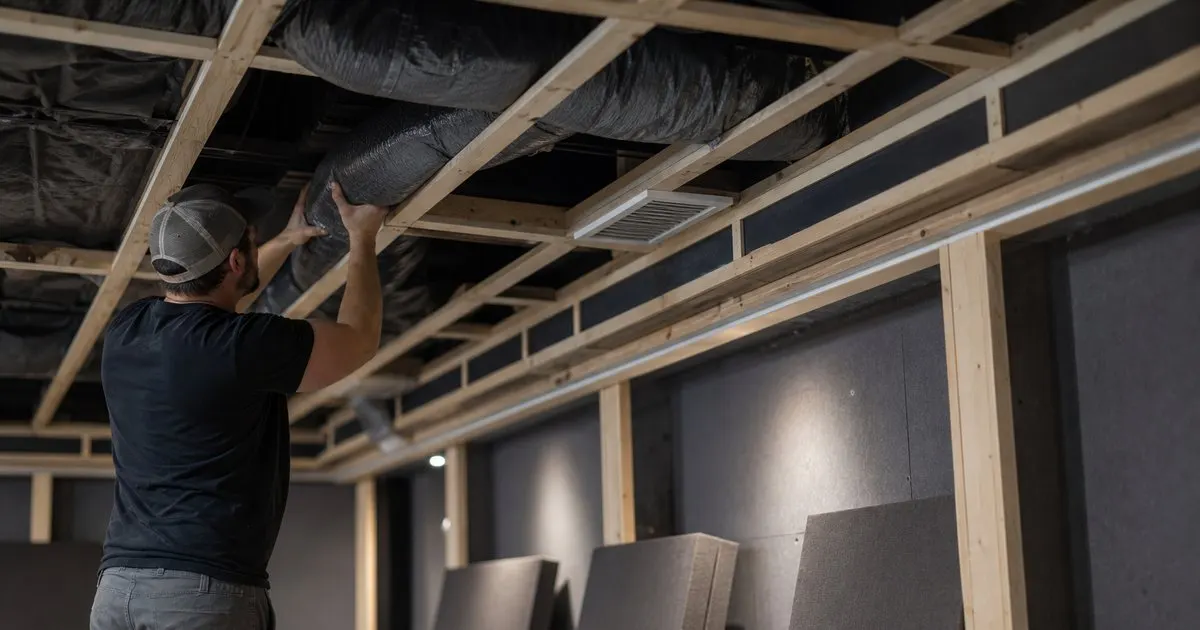
Why a well-isolated cinema needs its own ventilation plan
The measures that make a cinema quiet also make it airtight. Double drywall on isolation clips, solid-core doors with perimeter seals, sealed penetrations, all of it stops air movement as effectively as it stops sound. Once the door closes with six people, a projector, and a rack of amplifiers inside, the temperature climbs and the air grows stale within an hour or so. Guests get drowsy, the projector's fan ramps up, and the room starts to feel close in a way that undermines every dollar spent on the picture. A dedicated cinema therefore needs a deliberate supply and return path, sized for the heat load rather than borrowed from the adjacent hallway. Related: How dark does a dedicated home cinema room need to be?
The heat load is larger than most homeowners expect. A projector in a bright mode, a stack of power amplifiers, a processor, source components, and a full row of bodies together add up to a meaningful thermal load in a small sealed volume. The mechanical designer should estimate that load from the equipment list rather than from square footage alone. Basements bring the added complication of humidity, so the system often needs a dehumidification strategy as well, since damp air is hard on electronics, on fabric wall treatments, and on the comfort of anyone sitting still for two hours.
Keep reading: How dark does a dedicated home cinema room need to be?, Which projector technology delivers the best image in a light controlled room?, What acoustic treatments actually transform a home theater listening experience?. See how Theatrvault helps you an expert guide to designing a true home cinema.
Where the noise comes from and how to design it out
Mechanical noise reaches the seats by three routes: air rushing through undersized ducts and grilles, fan and compressor vibration carried through the structure, and sound from the rest of the house traveling along the duct itself. Air noise is the easiest to solve. Oversize the ducts so air moves at low velocity, use large grilles with wide open area, and avoid sharp bends near the room. Designers typically aim for very low noise criteria targets in a dedicated cinema, in the low twenties or below, which is far quieter than a normal living space, and low air velocity is the first prerequisite. Related: Which projector technology delivers the best image in a light controlled room?
Vibration and flanking take more planning. The air handler or fan coil should sit outside the isolated shell, ideally in a mechanical space some distance away, connected through flexible duct sections that break the rigid path. Runs should be lined or wrapped, include a few gentle bends, and where possible pass through an in-line duct silencer or a lined plenum. Supply and return should enter the room from separate points so they do not short-circuit the airflow, and both should be routed so there is no straight, unobstructed duct connecting the cinema to a bedroom or a kitchen. That last point is a common failure in otherwise well-built rooms. Related: Why does screen size depend on viewing distance more than budget?
Equipment choices that suit a cinema
A dedicated ducted system serving only the cinema is the reference approach, since it can be sized for the actual load and run at a low, steady fan speed rather than cycling hard. Variable-speed equipment helps because it can hold the room within a narrow band instead of blasting on and off. Ductless mini-split heads mounted inside the room are tempting for retrofits, and they do cool efficiently, but the indoor unit's fan and refrigerant hiss are audible during quiet passages, and the wall penetration for line sets needs careful sealing. If a mini-split is unavoidable, a ducted mini-split with the indoor air handler outside the shell is the better compromise. Related: Should you build a dedicated cinema or a multipurpose media room?
Fresh air matters as much as temperature. A room can be cool and still feel stale, because comfort depends on carbon dioxide and humidity, not only on the thermostat reading. An energy recovery ventilator or a dedicated fresh-air intake on the return side keeps the air renewed without dumping outdoor heat into the space. Equipment racks deserve their own attention: a rack closet with its own exhaust path prevents amplifier heat from ever entering the seating area, and it doubles as the quietest place to put projector and source noise.
Coordinating the mechanical trade with the cinema designer
The single most common mistake is bringing in the HVAC contractor after the isolation design is fixed. Every duct penetration through the isolated shell needs a plan for maintaining the sound seal, and every register location must avoid the speaker and acoustic panel positions on the walls and ceiling. The cinema designer, the acoustician if one is involved, and the mechanical contractor should review one coordinated drawing before rough-in. Ceilings are especially crowded in a cinema, with height speakers, lighting, and projector mounts all competing with duct routes.
Commissioning is where the plan gets verified. Ask for the system to be balanced with the room at its typical occupancy setting, then sit in the main seat with the film paused and listen. If you can hear air, the grille or duct velocity is too high. If you hear a low hum, the equipment is coupled to the structure somewhere. Both are fixable at that stage; neither is pleasant to fix after the walls are finished and the fabric is stretched. A short written commissioning report is worth requesting from any contractor working on a room at this level.
- An isolated cinema is effectively airtight and needs a dedicated supply and return sized for equipment and occupant heat.
- Low duct velocity, large grilles, lined runs, and gentle bends remove most air noise before it starts.
- Keep the air handler outside the isolated shell and break rigid duct paths so vibration and flanking sound cannot reach the seats.
- Coordinate the mechanical plan with the acoustic design before rough-in, then commission the system by listening from the main seat.

Julien Jimenez
Julien Jimenez is an independent software builder based in Paris. He designs, ships, and operates focused SaaS products for small businesses and independent professionals. Read the full author page.
A Cinema Kept Behind Your Own Door
An expert guide to designing a true home cinema. Theatrvault is built to help you put this into practice.
Design your cinemaMore from the Theatrvault blog
Get the complete home cinema rooms guide
Our full buying guide, the price guide, and new research as we publish it. One email, no spam, unsubscribe any time.