What should a homeowner do when the projector fan is audible from the seats?
Even a superb projector can spoil a quiet scene if its cooling fan whirs above the heads of the audience. These are the fixes, from a settings change to a purpose-built enclosure.
Why the fan is audible, and why it matters more in a good room
Projectors generate a great deal of heat in a small chassis, and the only way to remove it is with forced air. Manufacturers publish noise figures for their units, but these are measured under standardized conditions that rarely match a real room, and the figure in the brightest mode is often meaningfully louder than the one on the specification sheet. In an ordinary living room, ambient noise from the house masks the fan. In a properly isolated cinema with a very low background level, the same fan becomes the loudest thing in the room during a quiet scene, sitting a few feet above the back row where the ear is most sensitive to it. Related: Should you build a dedicated cinema or a multipurpose media room?
Several factors make a given projector louder in practice. High brightness or high lamp mode drives the fan harder. A warm room, or a projector mounted in a ceiling pocket with poor airflow, causes the thermal management to ramp up. Clogged intake filters restrict air and raise fan speed. A mount that couples the chassis to a drywall ceiling turns the whole ceiling into a sounding board. And distance matters: a projector positioned directly over the seats is far more intrusive than one at the back wall behind them, even if the sound level is identical. Related: Which projector technology delivers the best image in a light controlled room?
Keep reading: How dark does a dedicated home cinema room need to be?, Which projector technology delivers the best image in a light controlled room?, What acoustic treatments actually transform a home theater listening experience?. See how Theatrvault helps you an expert guide to designing a true home cinema.
The quick fixes to try first
Start with settings. Many rooms have more brightness than they need, especially with a modern laser projector on a moderately sized screen, and switching to a lower light output mode drops fan speed audibly with no visible loss in a dark room after calibration. Clean or replace the intake filters and confirm that nothing blocks the vents. Check that the room itself is not running warm, because the projector's cooling is working against the ambient temperature; a cinema that sits a few degrees cooler runs its projector quieter. Related: How dark does a dedicated home cinema room need to be?
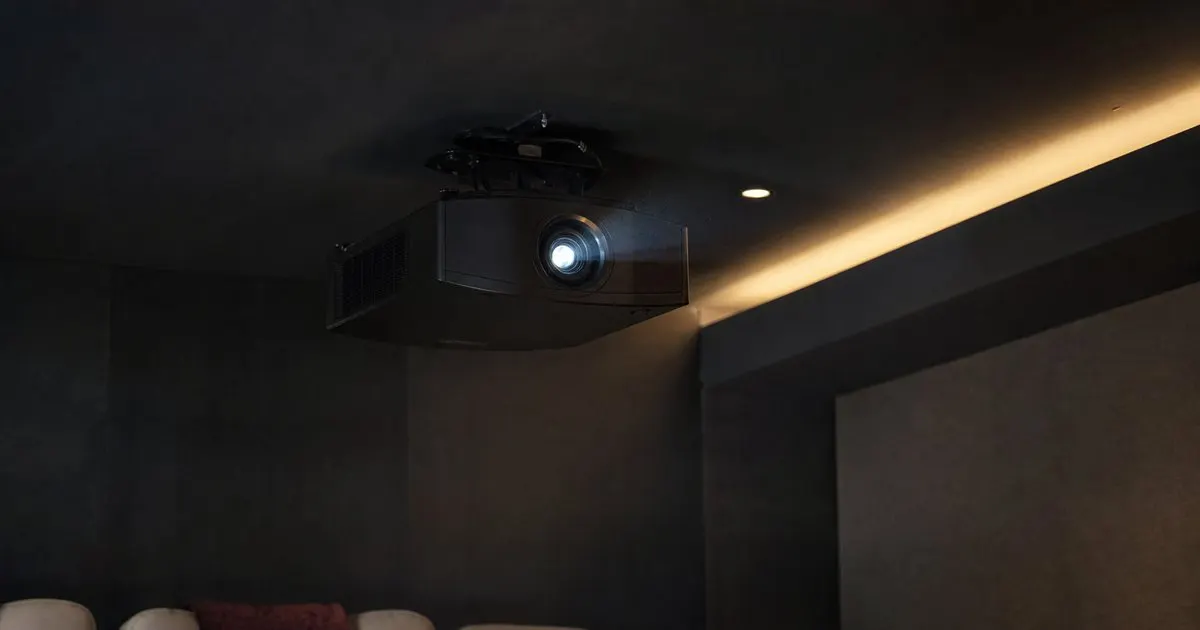
Then look at the mount. A rigid mount bolted to a drywall ceiling transmits fan vibration into the structure, where it radiates as a low hum. Isolation pads or a mount designed with vibration damping break that path. If the projector sits directly above the main seats, consider whether a longer throw from the back wall is possible with the existing lens; moving the noise source several feet farther back and behind the listeners' heads reduces its subjective loudness considerably. These steps cost little and often resolve the complaint entirely.
Building a hush box that actually works
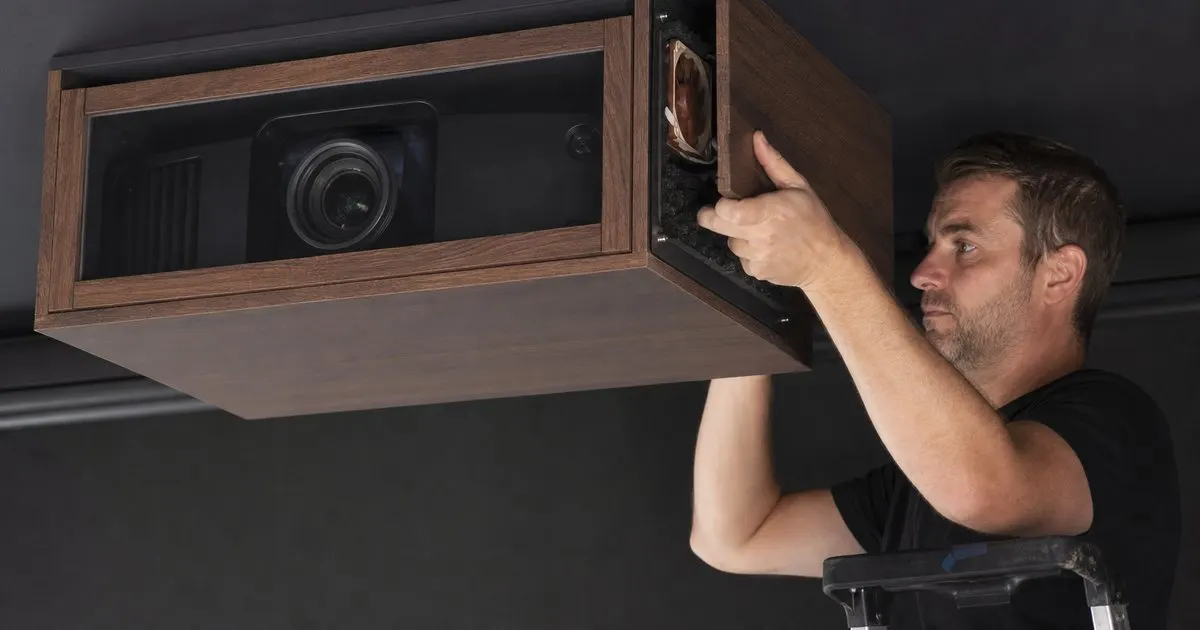
When the fixes above are not enough, the answer is an enclosure, commonly called a hush box: a sealed, lined cabinet around the projector with a glass port for the lens and its own ventilation. The concept is simple, but the details determine whether it succeeds. The box must move enough air to keep the projector at its normal operating temperature, or the projector's internal fan will run faster and the enclosure becomes pointless. That means a quiet, appropriately sized fan or two, an intake and exhaust that are baffled so sound cannot escape in a straight line, and ideally ducting that carries the warm air out of the room altogether.
The port glass needs to be optical quality with anti-reflective coating on both sides, mounted with a very slight tilt so that any residual reflection does not fall back through the lens, and kept clean. Ordinary window glass reduces brightness and adds a faint ghost image. The interior should be lined with dense absorptive material, the box mounted on isolation from the structure, and a removable panel provided for access to the projector's filters and lens controls. A temperature sensor inside the enclosure, visible or tied to the control system, gives early warning if a fan fails.
The projection booth alternative and choosing a quieter unit
In rooms with an adjacent closet or hallway behind the rear wall, the most elegant solution is to put the projector outside the room entirely, shooting through a sealed port window in the wall. This is how commercial cinemas work, and it removes both fan noise and heat from the auditorium with no enclosure at all. It requires enough throw distance for the lens, a port with the same optical-grade glass described above, and a way to keep the booth space cool and ventilated. Planning this during construction is straightforward; retrofitting it depends entirely on what lies behind the back wall.
If a new projector is on the table anyway, noise should be a real selection criterion, not an afterthought. Larger chassis with bigger, slower fans are generally quieter than compact units with the same light output. Laser light sources let you reduce output without the color shift of a dimmed lamp, which makes the quiet modes more usable. Ask to hear the candidate projector in a quiet demonstration room in its calibrated mode, not in the brightest mode on a showroom floor. As an independent guide we may earn a commission on some products we recommend; on this point, the advice is to trust your ears in a quiet room over any number on a specification sheet. Related: Why does screen size depend on viewing distance more than budget?
- Fan noise stands out in a dedicated cinema because the room's background is far quieter than a living room.
- Try lower light output modes, clean filters, a cooler room, and a vibration-isolated mount before anything structural.
- A hush box works only if it moves enough air quietly, uses optical-grade anti-reflective port glass, and is lined and isolated.
- Where the layout allows, a projector booth behind the rear wall removes both noise and heat from the room entirely.

Julien Jimenez
Julien Jimenez is an independent software builder based in Paris. He designs, ships, and operates focused SaaS products for small businesses and independent professionals. Read the full author page.
A Cinema Kept Behind Your Own Door
An expert guide to designing a true home cinema. Theatrvault is built to help you put this into practice.
Design your cinemaMore from the Theatrvault blog
Get the complete home cinema rooms guide
Our full buying guide, the price guide, and new research as we publish it. One email, no spam, unsubscribe any time.