Why does a new projector still need professional calibration before its first screening?
A premium projector arrives with picture modes tuned for a showroom, not for your screen, your room, or your eyes. Calibration closes that gap, and the difference is visible from the first frame.
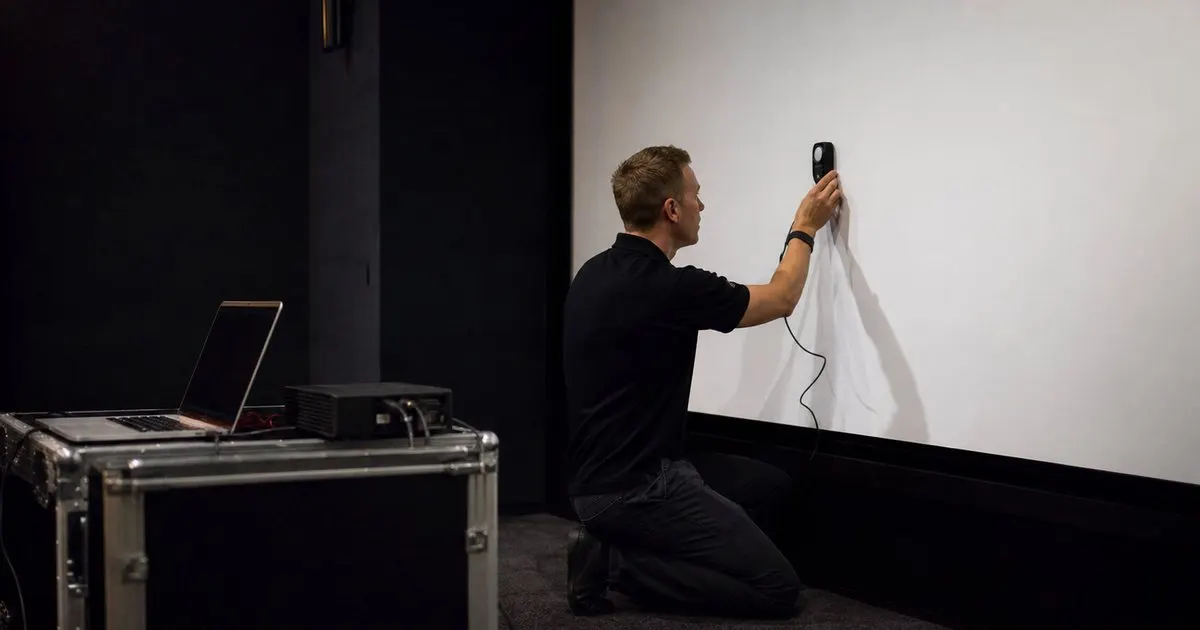
Factory modes are a starting point, not a finish
Manufacturers ship projectors with several picture presets, and the most accurate of them is usually close but not correct for any particular room. Two identical units off the same production line differ slightly in their color filters, lamps or laser modules, and panel alignment. Beyond unit variation, the preset assumes a nominal screen: a certain gain, a certain size, a neutral white. Your screen has its own gain and tint, your throw distance and zoom position change how much light reaches it, and your walls reflect a small amount of that light back. None of that can be known in a factory. Related: Why does screen size depend on viewing distance more than budget?
The result is that the out-of-box image often runs slightly cool or green in the grays, has a gamma curve that crushes shadow detail or lifts blacks, and reproduces colors that are somewhat oversaturated in a way that looks impressive in a store and fatiguing over a two-hour film. A calibrator measures what the projector actually puts on your screen with a spectroradiometer or colorimeter and adjusts the internal controls until measured white, gray steps, and primary and secondary colors match the standards the content was mastered to. The film then looks the way its colorist intended.
Keep reading: How dark does a dedicated home cinema room need to be?, Which projector technology delivers the best image in a light controlled room?, What acoustic treatments actually transform a home theater listening experience?. See how Theatrvault helps you an expert guide to designing a true home cinema.
What the calibrator actually adjusts
The process starts with the basics: correct aspect and overscan, sharpness and noise reduction set so they add nothing artificial, and brightness and contrast set so black detail is visible and highlights are not clipped. Then comes grayscale, the tint of every shade from black to white, which is adjusted through the projector's white balance controls so all grays are neutral. Gamma is set to a target appropriate for a dark room, which determines how quickly the image climbs out of black and is responsible for much of what people perceive as depth and dimensionality. Related: How dark does a dedicated home cinema room need to be?
Color management follows, tuning the hue, saturation, and brightness of the primaries and secondaries so that reds, skin tones, and foliage sit where they should. With high dynamic range content the work is more involved, because a projector cannot reach the peak brightness of the mastering display and must map the content's range onto its own real output. A calibrator measures the actual peak light on your screen and sets the tone mapping so highlights retain detail while the mid-range stays bright enough to feel like HDR. This is the step that most often separates a disappointing HDR experience from a convincing one. Related: Which projector technology delivers the best image in a light controlled room?
When to calibrate, and how often
The ideal moment is after installation is complete and the room is in its final state: screen mounted, finishes done, lighting scenes set, and the projector in its permanent position with lens memory positions stored. Lamp-based projectors settle over their first stretch of use, so many calibrators suggest a short break-in period before fine adjustment; laser and LED light sources are more stable from the start but still benefit from a few hours of use. If the room is being built by an integrator, calibration is often the final commissioning step, and it is worth confirming whether it is included or priced separately. Related: What is the best way to light a home cinema without washing out the picture?
Light output drifts as a lamp ages, and a laser source also declines slowly over its long life, so a recalibration every couple of years, or after a lamp change, keeps the picture on target. Some owners also ask for separate calibrated modes for standard content, HDR, and a brighter mode for a partially lit room. Modern projectors let a calibrator store all of these, and a well-designed control system then selects the right mode automatically based on the source signal, so nobody has to think about it.
Choosing a calibrator and what to expect
Look for someone certified by one of the established display calibration training programs, who owns a reference-grade meter and a pattern generator rather than relying on the projector's internal patterns, and who is willing to provide before and after measurement reports. Ask how they handle HDR on projectors specifically, because that is where skill and current knowledge matter most. A calibrator who works regularly with high-end projection will also notice installation issues, such as a slight focus fall-off at the screen edge or an unexpected uniformity problem, that an owner might otherwise live with unknowingly.
Fees vary by region and by the number of modes and sources involved; a full session on a projector with several modes typically costs a few hundred dollars and rises from there for complex multi-source rooms. Against the price of a projector and screen in this category, that is a small share of the total, and it is the one line item that affects every minute of viewing. As an independent guide we may earn a commission on some equipment recommendations; calibration is a service we simply recommend because the improvement is not subtle.
- Factory picture modes cannot account for your screen's gain, your throw distance, or unit-to-unit variation.
- Calibration corrects grayscale, gamma, and color, and it sets HDR tone mapping to your projector's real peak output.
- Schedule calibration after the room is finished and the projector is in its permanent position, then repeat every couple of years or after a lamp change.
- Choose a certified calibrator with a reference meter and pattern generator who provides before and after reports.

Julien Jimenez
Julien Jimenez is an independent software builder based in Paris. He designs, ships, and operates focused SaaS products for small businesses and independent professionals. Read the full author page.
A Cinema Kept Behind Your Own Door
An expert guide to designing a true home cinema. Theatrvault is built to help you put this into practice.
Design your cinemaMore from the Theatrvault blog
Get the complete home cinema rooms guide
Our full buying guide, the price guide, and new research as we publish it. One email, no spam, unsubscribe any time.